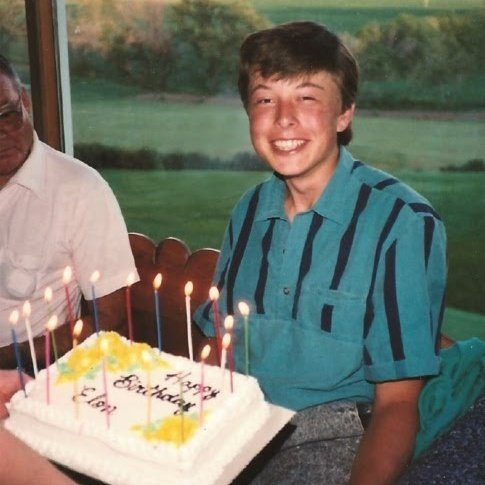
Happy Birthday Elon
When Elon left South Africa, his mother provided him with $2,000 by cashing out a stock account she had opened with the money she won in a beauty contest as a teenager.
What he mainly had with him when he arrived in Montreal was a list of his mother’s relatives he had never met.
He planned to call his mother’s uncle, but discovered that he had left Montreal. So he went to a youth hostel, where he shared a room with five other people.
“I was used to South Africa, where people will just rob and kill you,” he says.
“So I slept on my backpack until I realized that not everyone was a murderer.”
He wandered the town marveling that people did not have bars on their windows.
After a week, he bought a $100 Greyhound Discovery Pass that allowed him to travel by bus anywhere in Canada for six months. He had a second cousin his age, Mark Teulon, who lived on a farm in Saskatchewan province not far from Moose Jaw, where his grandparents had lived, so he headed there. It was more than 1,700 miles from Montreal.
The bus, which stopped at every hamlet, took days to wander across Canada. At one stop, he got off to find lunch and, just as the bus was leaving, ran to jump back on.
Unfortunately, the driver had taken off his suitcase with his traveler’s checks and clothes. All he had now was the knapsack of books he carried everywhere. The difficulty of getting traveler’s checks replaced (it took weeks) was an early taste of how the financial payments system needed disruption.
When he got to the town near his cousin’s farm, he used some of the change he had in his pocket to call.
“Hey, it’s Elon, your cousin from South Africa,” he said.
“I’m at the bus station.”
The cousin showed up with his father, took him to a Sizzler steak house, and invited him to stay at their wheat farm, where he was put to work cleaning grain bins and helping to raise a barn.
There he celebrated his eighteenth birthday with a cake they baked with “Happy Birthday Elon” written in chocolate icing.
After six weeks, he got back on the bus and headed for Vancouver, another thousand miles away, to stay with his mother’s half-brother.
When he went to an employment office, he saw that most jobs paid $5 an hour.
But there was one that paid $18 an hour, cleaning out the boilers in the lumber mill.
This involved donning a hazmat suit and shimmying through a small tunnel that led to the chamber where the wood pulp was being boiled while shoveling out the lime that had caked on the walls.
“If the person at the end of the tunnel didn’t remove the goo fast enough, you would be trapped while sweating your guts out,” he recalls. “It was like a Dickensian steampunk nightmare filled with dark pipes and the sound of jackhammers.”
Source: Walter Isaacson's 'Elon Musk' (2023), chapter 6